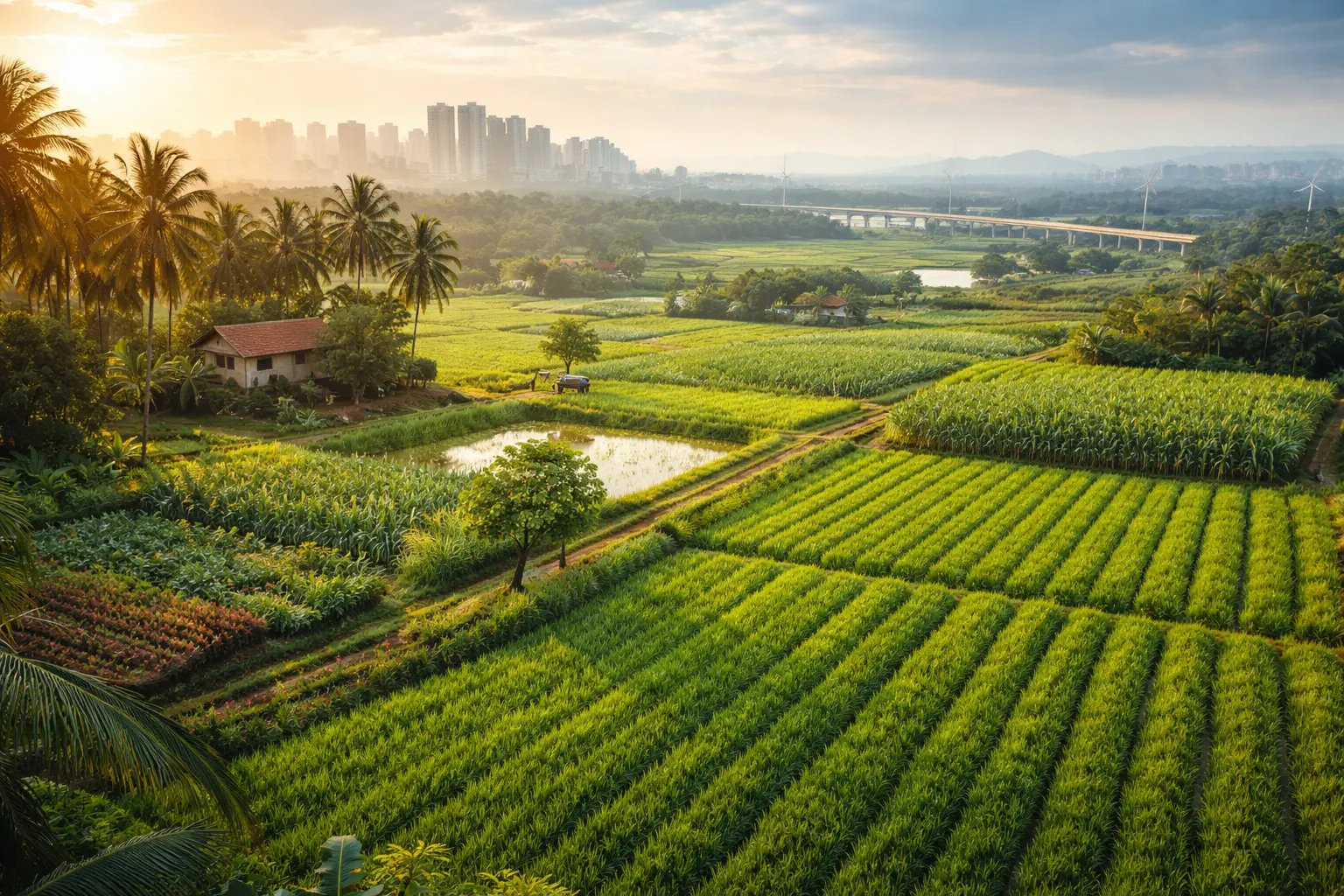
Farmland investing in India is entering a new phase in 2026. It is no longer viewed only as an emotional purchase or a retirement dream. Investors are now evaluating agricultural land as a structured, long-term asset class.
Rising food demand, urban expansion, infrastructure growth, and agri-tech innovation are reshaping how farmland performs as an investment. But unlike hype-driven narratives, the real opportunity lies in disciplined selection and long-term thinking.
Why 2026 Is a Turning Point for Farmland Investing in India
The farmland market in India has matured significantly over the past few years. Earlier, transactions were largely unorganized and driven by local buyers. Today, urban professionals, NRIs, and portfolio investors are entering this space.
Food consumption patterns are shifting as incomes rise. Demand for fresh produce, fruits, and chemical-free crops is increasing steadily. At the same time, available agricultural land near growing cities is shrinking.
This combination of rising demand and limited supply is creating structural support for farmland values, particularly in well-connected regions.
Economic Growth, Food Demand and Land Scarcity
India continues to experience strong economic growth compared to many global markets. As disposable income increases, food consumption also becomes more diverse and quality-focused.
Urban households are spending more on organic produce, dairy products, and high-value crops. This shift strengthens the long-term viability of productive farmland.
However, arable land per person is declining. Urbanization, highways, industrial corridors, and housing projects are reducing agricultural land near cities. This scarcity plays a direct role in driving land appreciation over time.
Not all farmland benefits equally. Growth is highly location dependent.
Government Policies Reshaping Agricultural Land Ownership
Land laws in India remain state-specific, which makes policy awareness essential before investing. Certain states have eased restrictions to attract investment into agriculture.
For example, reforms in Karnataka have made it easier for non-farmers to purchase agricultural land under defined conditions. Such changes have increased participation from urban investors.
Digital platforms like eNAM have improved transparency in agricultural trade by connecting farmers directly with buyers. Meanwhile, support schemes such as Pradhan Mantri Kisan Samman Nidhi have strengthened farmer stability.
Even with reforms, investors must carefully verify eligibility rules, land ceiling limits, and classification before purchasing agricultural land.
ROI in 2026: What Returns Are Realistic?
Farmland generates returns through appreciation, leasing income, or managed cultivation. Capital appreciation is usually the primary driver of long-term gains.
Land located near expanding cities like Bengaluru and Hyderabad has historically shown stronger appreciation because of infrastructure growth and urban sprawl.
In high-growth corridors, appreciation may range between eight to fifteen percent annually over long holding periods. In stable rural belts, returns tend to be moderate but steady.
Lease income usually provides modest annual yield. Managed farming models may offer higher returns, but they also involve operational risk. Farmland should always be evaluated with a long-term horizon of at least seven to ten years.
Best Locations for Farmland Investment in India
Location remains the most important factor in farmland performance. Proximity to highways, industrial corridors, and expanding city boundaries significantly influences value.
In Karnataka, farmland around Bengaluru has attracted investors due to infrastructure development and demand for farm stays. Maharashtra has seen growth around Pune and Nashik, especially in horticulture and vineyard zones.
Telangana’s rapid development around Hyderabad has also influenced land prices in nearby agricultural belts. Tamil Nadu and Madhya Pradesh offer comparatively lower entry prices, making them attractive for long-term investors.
Choosing the right district often matters more than choosing the right crop.
The Rise of Organic Farming and Sustainable Agriculture
Sustainability is becoming a commercial advantage rather than just an environmental idea. Consumers are willing to pay premiums for chemical-free produce and responsibly grown crops.
Farmland suitable for organic certification can command higher valuation over time. Export-oriented organic farming also offers better revenue potential.
Land with reliable water sources and healthy soil quality is likely to outperform degraded or water-stressed land in the coming years. Investors who consider sustainability factors early may benefit from long-term demand trends.
Agri-Tech and Its Impact on Farmland Returns
Technology is reducing uncertainty in agriculture. Precision irrigation, satellite monitoring, and soil analytics allow better decision-making and improved yield prediction.
Professional farm management companies are also emerging, making it easier for non-farmers to participate without hands-on involvement.
Agri-tech integration is likely to strengthen farmland’s investment profile by improving operational efficiency and reducing risk. In the future, managed farmland projects may become more structured and data-driven.
Farmland vs Other Investments
Compared to residential real estate, farmland is less liquid but may offer stronger appreciation in select growth corridors. Residential properties usually provide predictable rental income, whereas farmland income can vary.
Compared to gold, farmland has the advantage of generating potential operating income in addition to capital growth. However, gold remains easier to buy and sell.
Compared to equities, farmland offers lower volatility but slower compounding. It works best as a diversification tool within a balanced portfolio rather than as a standalone investment strategy.
Who Should Invest in Farmland?
Farmland is best suited for long-term investors who are comfortable with limited liquidity. High net-worth individuals and NRIs looking to diversify may find it appealing.
Investors seeking inflation protection or exposure to sustainable assets may also consider farmland.
It is not ideal for short-term traders or individuals seeking quick cash flow. Patience is a core requirement in this asset class.
How to Invest in Farmland the Right Way
The first step is defining your objective. Some investors focus on appreciation, while others prioritize income or lifestyle use.
After selecting a state and district, legal eligibility must be confirmed. Title verification, encumbrance checks, and land classification reviews are mandatory.
Soil quality and water access should be physically inspected. Proper registration and documentation ensure long-term security.
Field visits and independent legal advice are always recommended before finalizing any purchase.
Long-Term Outlook: Will Farmland Prices Rise Beyond 2026?
Several structural forces support long-term farmland demand in India. Food consumption will continue to grow as the population expands and income levels rise.
Urban sprawl and infrastructure development will keep influencing land prices in peri-urban belts. Export opportunities and agri-tech adoption may also strengthen productivity and profitability.
However, growth will not be uniform across all regions. Prime locations near expanding cities are likely to outperform remote, water-stressed areas.
Farmland investing in 2026 is not about speculation. It is about careful selection, regulatory awareness, and disciplined long-term allocation.